
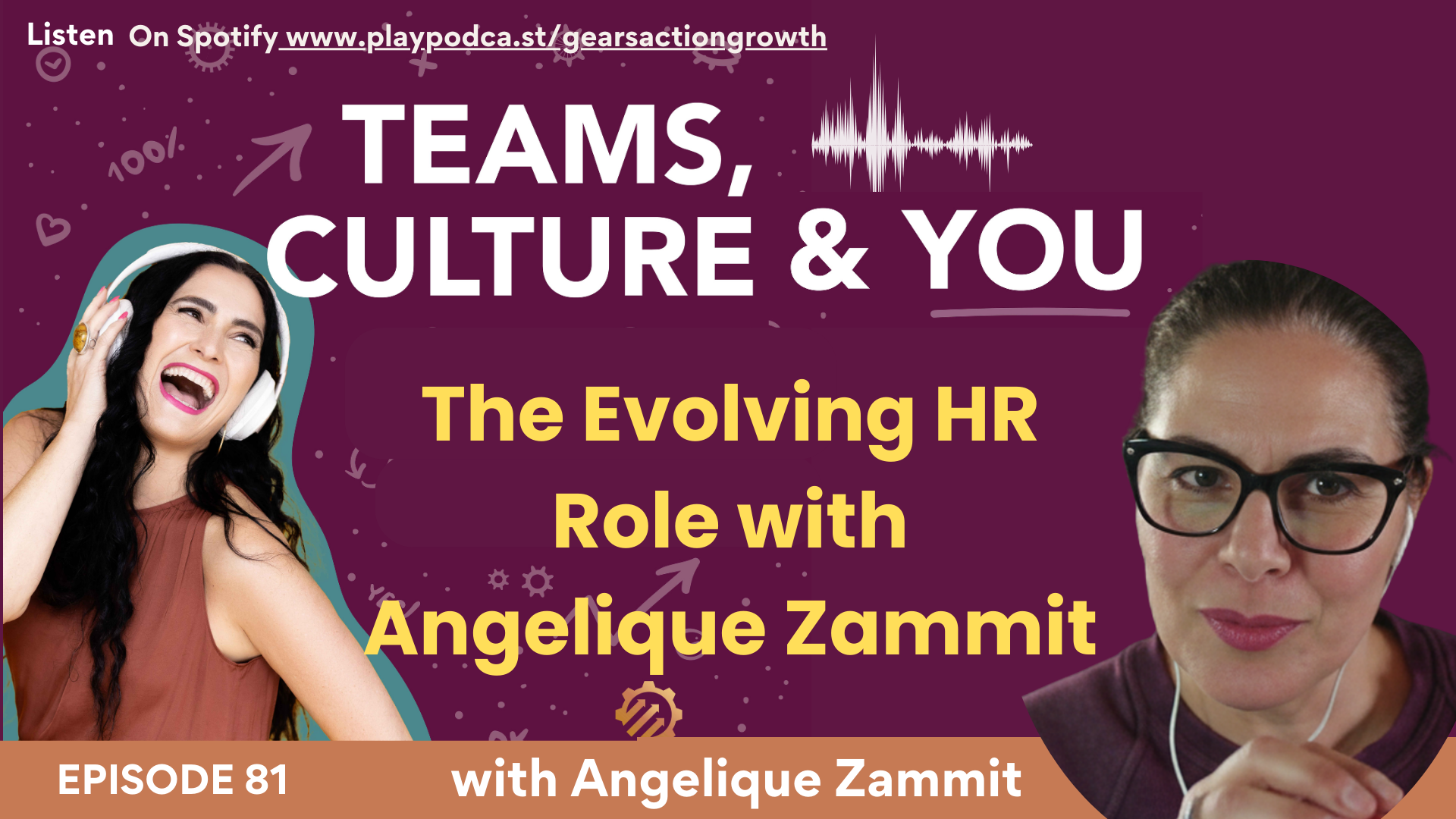

The role of HR has changed more in the last two decades than in the previous fifty. In this episode of Culture, Teams & You, I sat down with Angelique Zammit, a highly experienced HR leader who has led people and culture functions across manufacturing, technology, retail, tourism and professional services, to explore what this evolution really means for today’s HR professionals.
What emerged was a deeply practical, honest conversation about strategic HR, HR leadership, and the capabilities required for the future of HR—particularly in a world shaped by constant disruption, AI, and organisational uncertainty .
Angelique’s career began at a time when HR was still largely known as “personnel”- focused on leave management, payroll, recruitment administration and compliance. Early HR functions were process-driven, paper-based, and often siloed from the core business.
Over time, recruitment, performance management and structured HR processes emerged. Yet even as HR matured, it was often positioned as the “conscience of the organisation”—responsible for culture, behaviour and ethics.
As Angelique powerfully notes, this framing is flawed. Culture is not HR’s responsibility alone—it is every leader’s responsibility. When HR is positioned as a moral safety net rather than a business partner, it limits the function’s impact and authority .
Having frequently been the only woman—and the only HR leader—at the executive table, Angelique reflects candidly on navigating bias, mansplaining and credibility challenges.
Early in her career, she learned that emotional defence rarely shifts perception. Instead, influence comes from:
· reading the room
· understanding power dynamics
· asking strategic questions
· reframing conversations in business language
These experiences shaped her leadership philosophy and reinforced a core truth: HR leadership is fundamentally about influence, not control .
One of the most important shifts in the evolving HR role is moving beyond process advocacy into HR strategy.
Angelique describes the moment HR gains traction with leaders: when conversations shift from “process” to performance, productivity and margin.
By asking questions such as:
· revenue per employee
· workforce cost versus value creation
· talent allocation in growth areas
HR moves from being perceived as a “nice to have” to a strategic partner influencing real business decisions .
This is where people stop being “our most valuable asset” in theory—and start being treated
A recurring tension explored in the conversation is the disconnect between rhetoric and reality. While leaders often claim people are critical, executive incentives remain heavily weighted toward financial targets.
Angelique explains this clearly:
· businesses exist to generate financial outcomes
· executive remuneration reinforces short-term results
· people metrics are harder to measure and standardise
This creates a structural challenge for HR professionals: how do you demonstrate the link between people decisions and business performance?
The answer, Angelique argues, is not telling—but showing .
Using restructuring as a powerful example, Angelique highlights how poorly planned change consistently leads to:
· productivity dips
· process breakdowns
· morale erosion
· rework and “redos”
Strategic HR leaders understand that the hardest part of change is not the restructure itself—but what life looks like after the change.
Sometimes, taking the “longer, shorter way”—allowing leaders to see the consequences of poor planning—creates the evidence needed to influence future decisions. This is where experience, judgement and HR leadership capability truly matter .
Looking ahead, Angelique is clear: stability is no longer the goal—adaptability is.
The future of HR will be shaped by: rapid technological change; AI and automation; workforce roles that don’t yet exist; and geopolitical and economic uncertainty.
HR professionals must develop new HR skills, including:
· strategic workforce planning
· external scanning and systems thinking
· comfort with ambiguity
· confidence to challenge knee-jerk cost-cutting responses
Crucially, HR must stop tinkering at the edges of AI implementation and instead ask bold, strategic questions about customer experience, value creation and organisational design.
One of the most important insights from the conversation is the growing role of HR in shaping learning capability.
As work, roles and technologies evolve faster than ever, organisations need:
· psychological safety to learn
· space to experiment
· mechanisms to turn learning into capability
HR professionals are uniquely positioned to design the conditions where learning is not optional—but embedded.
The evolution of HR is no longer about getting a seat at the table. It’s about using it.
The modern HR leader must:
· speak the language of the business
· influence without authority
· balance humanity with commercial reality
· lead through uncertainty
As Angelique’s career demonstrates, the most effective HR professionals are those who combine deep people insight with strategic courage.
🎧 Evolving HR Role with Angelique Zammit is available now on Culture, Teams & You.

If you’d like to share insights about building strong teams and cultures I would love to hear from you. Book a virtual coffee here